Popular Business Growth and Productivity Frameworks Every Business Owner Should Know
In this article
Popular Business Growth and Productivity Frameworks Every Business Owner Should Know
Many business owners want growth, but when we discuss growth deeply, the real question is usually not only about sales or marketing.
The real question is:
How do we think better, decide better, execute better, and improve continuously?
This is where business frameworks help.
A framework is not magic. It is simply a thinking tool. It gives structure to confusion. It helps business owners and teams look at problems in a more organised way.
Over the years, many business coaches, consultants, authors, and founders have used different frameworks for goal setting, productivity, strategy, execution, improvement, and scaling.
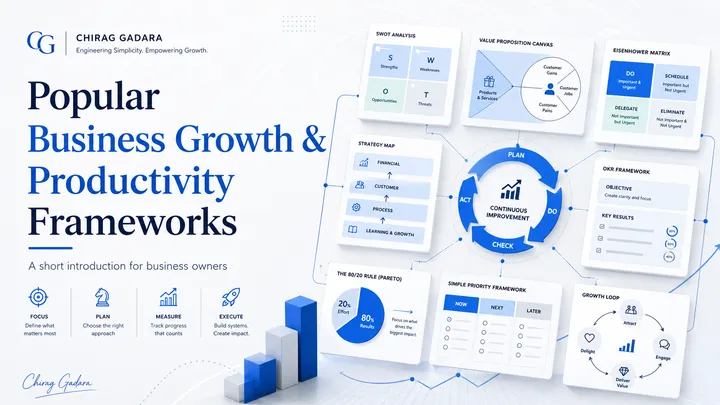
1. SWOT Analysis
Origin: Strategic planning and business analysis.
Purpose: To understand Strengths, Weaknesses, Opportunities, and Threats.
Benefit: SWOT helps a business owner see the current reality before making decisions. It is useful when starting a new plan, entering a new market, reviewing competition, or understanding why growth is stuck.
For SMEs, SWOT is a good mirror. Sometimes we think the problem is outside, but weakness may be inside the process, team, pricing, follow-up, or delivery system.
2. SMART Goals
Origin: Popularised in management thinking through goal-setting methods.
Purpose: To make goals Specific, Measurable, Achievable, Relevant, and Time-bound.
Benefit: SMART goals reduce vague planning. “Increase sales” is not a clear goal. “Increase repeat orders by 20% in 6 months” gives direction.
For business owners, this framework is useful because unclear goals create unclear execution.
3. OKRs
Origin: Popularised through Intel and later widely known because of companies like Google.
Purpose: To define Objectives and Key Results.
Benefit: OKRs help teams focus on what matters most. The objective gives direction, and key results define measurable progress.
This is useful when a business has many ideas but limited team bandwidth. OKRs help avoid the common SME problem: everyone is busy, but nobody is sure what is truly moving forward.
4. KPIs
Origin: Performance management practice.
Purpose: To track important business performance numbers.
Benefit: KPIs convert business activity into visibility. Sales conversion rate, pending payments, quotation delay, lead response time, production rejection rate, and customer complaints can all become KPIs.
The biggest benefit is simple: what is measured can be reviewed. What is reviewed can be improved.
5. Balanced Scorecard
Origin: Developed by Robert Kaplan and David Norton.
Purpose: To measure business performance beyond only financial numbers.
Benefit: It looks at business from multiple angles like finance, customers, internal processes, and learning or growth.
For SMEs, this is important because profit is not the only signal. A business may show revenue growth, but if customers are unhappy, team capability is weak, or processes are breaking, growth may not sustain.
6. Eisenhower Matrix
Origin: Inspired by the idea of separating urgent work from important work.
Purpose: To prioritise tasks based on urgency and importance.
Benefit: It helps owners stop treating every task as a fire.
Many business owners spend the whole day solving urgent issues — staff doubts, customer calls, payment reminders, delivery delays, small approvals. But important work like system building, hiring, training, review, and planning gets postponed.
This framework shows where time is really going.
7. Getting Things Done — GTD
Origin: David Allen’s productivity system.
Purpose: To capture, organise, and complete tasks without mental overload.
Benefit: GTD is useful for people who carry too many tasks in their head.
For business owners, this is very relatable. One owner may be remembering follow-ups, payments, staff issues, vendor commitments, quotations, and family work also. At some point, memory becomes a very weak management system.
GTD encourages capturing work outside the mind and processing it systematically.
8. The 80/20 Rule — Pareto Principle
Origin: Based on Vilfredo Pareto’s observation and later applied widely in business.
Purpose: To identify the few inputs that create the majority of results.
Benefit: It helps owners focus effort where impact is highest.
Maybe 20% of customers bring most repeat business. Maybe 20% of products create most profit. Maybe 20% of process mistakes create most complaints.
The point is not the exact number. The point is focus.
9. PDCA Cycle
Origin: Quality and continuous improvement thinking.
Purpose: Plan, Do, Check, Act.
Benefit: PDCA teaches improvement as a cycle, not a one-time activity.
This is very useful for process improvement. Instead of making big dramatic changes, a business can improve step by step. Plan a change, try it, check the result, and standardise or improve again.
It creates a culture of review.
10. Kaizen
Origin: Japanese continuous improvement philosophy.
Purpose: To improve small things continuously.
Benefit: Kaizen is powerful because it does not wait for a big transformation.
A small improvement in quotation format, lead follow-up timing, stock arrangement, machine maintenance checklist, or customer complaint tracking can create long-term benefits.
For SMEs, Kaizen is practical because it respects real business life. You do not always need a huge budget. Sometimes you need daily improvement discipline.
11. Lean Startup
Origin: Popularised by Eric Ries.
Purpose: Build, Measure, Learn.
Benefit: It helps businesses test ideas before investing too much.
This is not only for startups. Even SMEs can use it before launching a new product, offer, branch, service model, or software process.
Instead of assuming, test. Instead of overbuilding, learn faster.
12. 4DX — The 4 Disciplines of Execution
Origin: FranklinCovey execution methodology.
Purpose: To execute important goals while daily work continues.
Benefit: Many businesses do not fail because of poor ideas. They fail because daily routine kills strategic focus.
4DX helps teams focus on wildly important goals, track lead measures, maintain a scoreboard, and create accountability.
For owners, this is useful because execution needs rhythm, not only motivation.
13. EOS — Entrepreneurial Operating System
Origin: Popularised by Gino Wickman through Traction.
Purpose: To run business with clear vision, people, data, issues, process, and traction.
Benefit: EOS is useful for growing companies that want structure without making business too complicated.
It helps owners move from random management to operating rhythm.
14. Porter’s Five Forces
Origin: Michael Porter’s strategy work.
Purpose: To understand industry competition.
Benefit: It helps business owners see market pressure more clearly — competitors, suppliers, customers, substitutes, and new entrants.
This is useful before pricing decisions, expansion, product planning, or entering a new segment.
Frameworks Are Not a Replacement for Thinking
One important point.
A framework is useful only when applied honestly.
If we fill SWOT casually, define KPIs without review, create OKRs but never discuss progress, or write SMART goals only for presentation, nothing changes.
Frameworks do not grow business.
Clear thinking, disciplined execution, and regular review grow business.
Frameworks only support that journey.
A Simple Way to Start
Do not try to implement all frameworks together.
Start with these questions:
- Do I need clarity? Start with SWOT.
- Do I need focus? Start with OKRs or SMART goals.
- Do I need visibility? Start with KPIs.
- Do I need better time use? Start with Eisenhower Matrix.
- Do I need process improvement? Start with PDCA or Kaizen.
- Do I need execution rhythm? Start with 4DX or EOS.
The right framework depends on the current bottleneck.
Closing Thought
Every growing business reaches a stage where hard work alone is not enough.
The owner needs better thinking tools. The team needs clearer systems. The business needs a review rhythm.
Frameworks are not complicated theories. Used properly, they are simple lenses to see business more clearly.
And clarity is always a good starting point for growth.
If this made you think about your own business, share your thoughts. Which area needs more clarity right now — goals, team, sales, productivity, execution, or process improvement?

Chirag Gadara
System Thinker & Technopreneur
With over 18 years of experience across technology, automation, and enterprise systems, I help businesses eliminate bottlenecks and engineer simplicity for sustainable growth.