What I Learned About Growth from Curiosity, Clarity and Systems
In this article
What I Learned About Growth from Curiosity, Clarity and Systems
Many business owners want growth.
But when growth actually starts coming, the business also starts showing its weak points.
Follow-ups get missed. Quotations get delayed. Staff waits for the owner’s approval. Payments need personal reminders. Production has bottlenecks. CRM is there, but the team still works on memory. ERP is implemented, but confusion remains.
This is where I have realised one important thing:
Growth is not only about getting more leads, more orders, or more people. Growth needs stronger internal pillars.
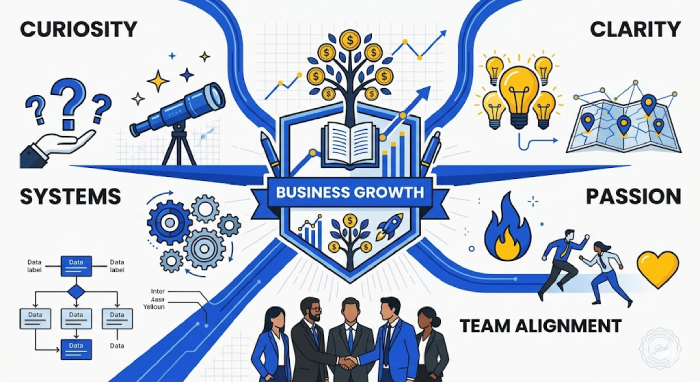
In my own journey, I observed five such basic pillars again and again:
`Curiosity, clarity, passion, system and team alignment.`
If any one of these is weak, growth becomes heavy. If all five are balanced, business starts becoming easier to manage.
1. Curiosity: The Starting Point of Growth
For me, everything started with curiosity.
- Why does this happen?
- Why is this process failing?
- Why does one business grow smoothly while another business remains dependent on the owner?
- Why do some teams take responsibility, while others wait for instructions?
Curiosity is not only about asking questions. It is about not accepting confusion as normal.
Many SME businesses run for years on habit. The owner knows everything in his mind. Staff knows “how we usually do it.” But nobody stops and asks, “Is this the right way?”
That question itself can become the beginning of improvement.
A curious business owner observes patterns. He notices that leads are not lost because the product is weak, but because follow-up is weak. He sees that payment delay is not always a customer problem, sometimes it is a reminder system problem. He understands that staff confusion may not be due to laziness, but unclear process.
Curiosity opens the door. Without it, we keep blaming people. With it, we start finding root causes.
2. Clarity: Software Cannot Fix Unclear Thinking
Curiosity gives knowledge. Knowledge slowly creates clarity.
And clarity is very important because software cannot fix unclear thinking.
If the sales process is not clear, CRM will only become a digital register. If production flow is not clear, ERP will only become extra data entry. If roles are not clear, task management software will only show pending tasks more beautifully.
Automation before clarity creates digital confusion.
Clarity means knowing:
- What exactly is the problem?
- Who is responsible?
- What should happen first?
- What should happen next?
- Where should the system alert us?
- What decision should the owner be able to take from the data?
In many businesses, the owner wants a dashboard. But the real question is: dashboard of what?
If the business does not define what matters, the dashboard becomes decoration.
Clarity converts noise into direction.
Peter Drucker’s management thinking often reminds us that what gets measured and managed properly improves over time. But before measurement, we need clarity about what is worth measuring.
3. Passion: Choosing the Work You Can Stay With
Passion is sometimes misunderstood.
It is not only excitement. Excitement comes and goes. Passion is the energy to stay with a problem long enough to solve it properly.
When curiosity helped me learn more, and clarity helped me understand better, I could choose what I truly wanted to work on — simplifying complex technology for business growth.
For an SME owner also, passion matters because business growth is not a one-day project. There will be slow days. There will be team issues. Clients will delay decisions. Systems will fail before they become stable.
If the owner is only chasing money, every problem feels like a burden. But when there is real passion for building something meaningful, problems become part of the process.
Passion gives patience.
And patience is needed because system building is not instant. It is like farming. You cannot shout at the seed every morning and ask why it has not become a tree.
4. System: Memory Is Not a Management System
This is one of the biggest problems I see in growing businesses.
The owner remembers everything.
Which customer needs follow-up. Which payment is pending. Which staff member is working on what. Which quotation was promised yesterday. Which order is stuck in production.
But memory is not a management system.
Memory works when the business is small. But when leads increase, staff increases, orders increase, and customer expectations increase, memory starts leaking.
A system is not only software. A system is a clear way of working.
Software is only the tool that supports that way of working.
A good system answers simple questions:
- What should be done?
- Who should do it?
- When should it be done?
- How will we know if it is delayed?
- What data will help us improve?
Michael Gerber, in *The E-Myth Revisited*, explains that a business should be built as a system, not only around the owner’s personal effort. This is very relevant for Indian SMEs.
If every decision needs the owner, the business is not scaling. It is only stretching the owner.
Marketing brings leads, but systems convert them.
5. Team Alignment: Growth Is a Team Sport
Even the best system fails if the team is not aligned.
Team alignment means everyone understands the goal, process, responsibility and expected outcome.
Many times, staff is blamed for poor performance, but the actual issue is unclear communication. One person thinks the task is urgent. Another thinks it can wait. One person updates on WhatsApp. Another updates in software. One person follows the old method. Another follows the new method.
Then the owner says, “Nobody follows the system.”
But the real question is: did we align the team properly?
Team alignment needs repetition, training, review and simple systems. Not one-time instruction.
A business owner must create a culture where people know:
- what success looks like
- where to update work
- when to escalate
- how to follow the process
- why the process matters
When team alignment is strong, the owner does not need to push everything personally. The business starts moving with rhythm.
A Simple Self-Check for Business Owners
If you want to diagnose your business quickly, ask these five questions:
- Are we curious enough to question old habits?
- Do we have clarity about our real bottlenecks?
- Are we passionate enough to stay with improvement work?
- Are we depending on memory or building systems?
- Is our team truly aligned, or only instructed?
These questions are simple. But honest answers can reveal a lot.
Final Thought
Business growth should reduce chaos, not multiply it.
If growth is creating more confusion, more dependency and more pressure on the owner, then maybe the business does not only need more sales. It needs stronger pillars.
- Curiosity helps us start asking better questions.
- Clarity helps us see the real problem.
- Passion gives us the energy to continue.
- System converts thinking into repeatable action.
- Team alignment makes growth sustainable.
For me, these five pillars are not theory. They are observations from real business situations, real mistakes, and real learning.
And maybe, if you look closely, you may find the same pattern in your own business too.
If this made you think about your own business, share your thoughts. Where do you feel this problem appears most — sales, team, operations, follow-up, or decision-making?

Chirag Gadara
System Thinker & Technopreneur
With over 18 years of experience across technology, automation, and enterprise systems, I help businesses eliminate bottlenecks and engineer simplicity for sustainable growth.
Previous Posts From Business Growth

Why Growth First Feels Like Chaos Before It Becomes Clarity

Everyone Wants an Autopilot Business. Few Are Ready to Build the Runway.

Growth Is Not Just Ambition, It Is Responsibility

Why Do Some Business Owners Keep Growing While Others Stay Stuck?