Why Businesses Struggle to Grow Sustainably

In this article
Why Businesses Struggle to Grow Sustainably
Starting a business is difficult.
But sustaining and growing a business is a completely different game.
In the beginning, everything runs on energy.
The owner remembers customers.
The owner handles complaints.
The owner follows up payments.
The owner checks orders.
The owner motivates the team.
The owner also knows which printer is not working.
This works in the early stage.
But after some time, the same style that helped start the business starts limiting the business.
Growth Brings Complexity
When business grows, everything increases.
More customers.
More staff.
More orders.
More complaints.
More follow-ups.
More decisions.
More small fires every day.
But many businesses still run with the same old method:
“I will remember.”
“Tell me once again tomorrow.”
“We will manage.”
“This is how we have always done it.”
This is where growth starts becoming heavy.
Not because the owner is incapable.
But because the business has grown beyond personal control.
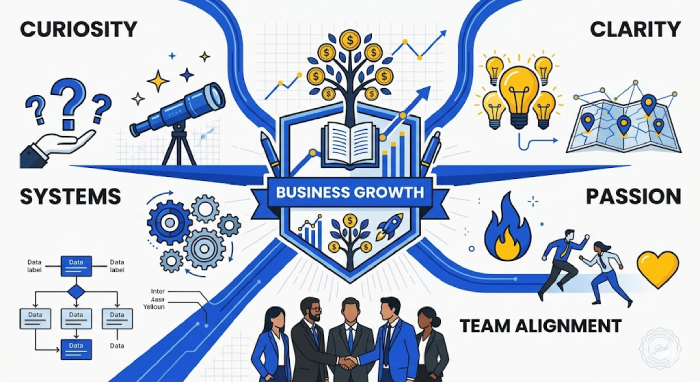
Passion Can Start a Business. Systems Sustain It.
Most SME owners are extremely hardworking.
But hard work alone cannot create sustainable growth.
A business needs:
- clear processes
- clear responsibility
- clear data
- clear communication
- clear review rhythm
Without this, the owner remains the central server of the company.
And if the owner is down, the whole system slows down.
In technology, we call this “single point of failure.”
In business, we usually call it “Sir busy che.”
The Real Reason Businesses Get Stuck
Many businesses don’t fail because of one big mistake.
They struggle because of many small unclear things repeated daily.
A lead is not followed up.
A customer complaint is not tracked.
A quotation is forgotten.
A payment reminder is delayed.
A staff member assumes someone else will do the work.
The owner gets update only when he asks.
Individually, these look small.
Together, they become growth leakage.
It is like a tyre with slow puncture.
You can still drive, but performance keeps dropping.
Owner-Dependent Business Cannot Scale Properly
In many SMEs, every important thing needs owner approval.
Customer discount? Ask owner.
Urgent dispatch? Ask owner.
Complaint? Ask owner.
Payment issue? Ask owner.
Staff confusion? Ask owner.
At one level, this gives control.
After one point, it creates bottleneck.
The business is not growing.
Only the owner’s headache is growing.
A healthy business should not depend on the owner for every small decision.
It should depend on systems, rules, visibility, and trained people.
Team Is Present, But Alignment Is Missing
Having employees is not the same as having a team.
A team needs direction.
If five people push a car in five different directions, everyone is working hard, but the car will not move properly.
Same thing happens in business.
Sales wants quick delivery.
Production wants proper planning.
Accounts wants payment clarity.
Customer wants update.
Owner wants peace.
Everyone is right.
But without a system, everyone pulls in their own direction.
Technology Alone Cannot Solve This
Many business owners think software will solve everything.
CRM, ERP, WhatsApp automation, task management, dashboard — all are useful.
But software cannot fix unclear thinking.
If the process is confused, software will only make the confusion digital.
Earlier confusion was in diary.
Now confusion is in login panel.
Looks modern, but problem same.
Technology works best when the business first has clarity.
What Great Thinkers Have Said
Michael E. Gerber, in The E-Myth Revisited, explains that a business should be built as a system, not just around the owner’s personal effort.
This is very important for SMEs.
Because if everything depends on the owner, the business is actually not independent.
James Clear writes in Atomic Habits:
“You do not rise to the level of your goals. You fall to the level of your systems.”
Every business owner wants growth.
But the business will grow only to the level of its systems.
Sustainable Growth Needs Rhythm
A growing business needs a rhythm.
Daily execution.
Weekly review.
Monthly planning.
Clear reporting.
Timely correction.
This does not need to be complicated.
Even simple review habits can change the business:
- Which leads are pending?
- Which orders are delayed?
- Which payments are stuck?
- Which customers complained?
- Which team member needs support?
- Which process failed repeatedly?
When these questions are asked regularly, business becomes more visible.
And visibility creates control.
Final Thought
Businesses struggle to sustain or grow when ambition grows faster than clarity.
Sales increases, but process does not.
Team increases, but alignment does not.
Customers increase, but service system does not.
Work increases, but review discipline does not.
Growth should not mean more chaos.
Real growth should create more control, more confidence, and more freedom.
A business becomes sustainable when it stops depending only on memory, firefighting, and owner involvement — and starts depending on clarity, systems, people, and discipline.
If this made you think about your own business, share your thoughts.
Where do you feel businesses struggle most — clarity, team alignment, process, data visibility, or owner dependency?

Chirag Gadara
System Thinker & Technopreneur
With over 18 years of experience across technology, automation, and enterprise systems, I help businesses eliminate bottlenecks and engineer simplicity for sustainable growth.
Previous Posts From Business Growth

Why Growth First Feels Like Chaos Before It Becomes Clarity

Everyone Wants an Autopilot Business. Few Are Ready to Build the Runway.

Growth Is Not Just Ambition, It Is Responsibility

Why Do Some Business Owners Keep Growing While Others Stay Stuck?