You Don’t Need to Understand Technology to Think in Systems

In this article
You Don’t Need to Understand Technology to Think in Systems
Many business owners hear the word “system” and immediately think of software.
CRM.
ERP.
Automation.
Dashboard.
Cloud.
API.
And then the mind says, “This is technical. Not for me.”
But system thinking is not about technology first.
System thinking is about understanding how work moves inside your business.
Technology comes later.
You Already Understand Systems
If you are running a business, you already understand systems.
You may not call it by that name.
When a customer inquiry comes, something should happen next.
Someone should reply.
Details should be collected.
Quotation should be sent.
Follow-up should happen.
Decision should be tracked.
That is a system.
When an order comes, material is checked, work is planned, dispatch happens, invoice is made, payment is followed up.
That is also a system.
Even making tea in the office has a system.
Water, tea powder, milk, sugar, boil properly, serve hot.
If someone changes the sequence too much, even tea can become a management issue.
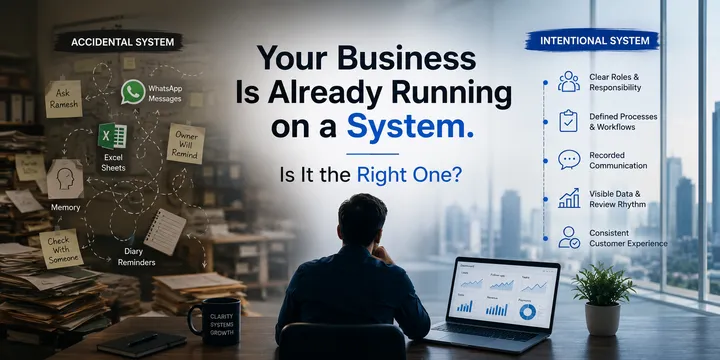
So the question is not whether your business has systems.
The real question is:
Are your systems clear, visible, and repeatable?
Start With Flow, Not Software
Before asking, “Which software should I buy?”, ask:
“What exactly happens from start to finish?”
Take one simple process: lead follow-up.
Write down:
- Where does the inquiry come from?
- Who receives it?
- Who should respond?
- What details must be collected?
- When should quotation be sent?
- How many follow-ups should happen?
- When should the owner be informed?
- When should the lead be marked lost?
- Why was it lost?
This is system thinking.
No coding required.
Just clarity.
Business Is Like a Railway Track
A train is powerful.
But without track, it cannot move safely.
Your team is the train.
Your process is the track.
Your software is the signal system.
Your data is the control room.
Many businesses buy the signal system before laying the track.
Then they say, “Software is not working.”
But software cannot decide your process for you.
It can only support a process that is already clear.
Use This Simple Formula
Any business activity can be understood in four parts:
1. Input
What starts the process?
Example: inquiry, order, complaint, payment due, purchase request.
2. Process
What steps should happen?
Example: assign, call, quote, approve, dispatch, remind, close.
3. Output
What result do we want?
Example: converted customer, delivered order, solved complaint, received payment.
4. Feedback
What did we learn?
Example: why lead was lost, why dispatch was delayed, why payment got stuck.
This simple thinking can improve sales, service, production, accounts, HR, purchase, and almost every area of business.
Technology simply makes this faster and more visible.
A Real Example: Payment Follow-Up
Many business owners say:
“Customers don’t pay on time.”
But system thinking asks better questions:
- Was payment due date recorded?
- Was reminder sent before due date?
- Who is responsible for follow-up?
- Was the customer called?
- Was the invoice received by the customer?
- Is there an aging report?
- When should owner be alerted?
Now the problem becomes clearer.
Earlier it was a complaint.
Now it is a process.
And once something becomes a process, it can be improved.
Systems Create Freedom, Not Restriction
Some people feel systems will make business rigid.
Actually, good systems create freedom.
When follow-ups are tracked, the owner is free from remembering everything.
When roles are clear, the team is free from confusion.
When data is visible, meetings are free from guesswork.
When process is defined, the business is free from dependency on one person.
James Clear writes in Atomic Habits:
“You do not rise to the level of your goals. You fall to the level of your systems.”
This applies perfectly to business.
Every owner wants growth.
But the business will grow only to the level of its systems.
How to Start Today
Pick one repeated problem in your business.
Not the biggest problem.
The most repeated one.
Then ask:
- What starts this process?
- Who handles it?
- What steps are required?
- Where does delay happen?
- What information is missing?
- What should be visible to the owner?
- What can be automated later?
This exercise alone can create more clarity than many long meetings.
And no, you don’t need to become technical for this.
You only need to observe your business honestly.
Final Thought
System thinking is not about becoming a software expert.
It is about becoming clear about how your business should work.
Technology is not the starting point.
Clarity is.
Once your process is clear, software, automation, and dashboards become powerful tools.
Without clarity, they become just another login password your team forgets.
So before asking, “Which software should we use?”
Ask:
“Which system should we build?”
That one question can change the way you look at business growth.
If this post made you think differently, share your thoughts.
Which part of your business needs system thinking first — sales, payments, operations, customer service, or team management?

Chirag Gadara
System Thinker & Technopreneur
With over 18 years of experience across technology, automation, and enterprise systems, I help businesses eliminate bottlenecks and engineer simplicity for sustainable growth.