The Third Person Theory: Why Problems Look Clear From Far Away

In this article
The Third Person Theory: Why Problems Look Clear From Far Away
Have you ever noticed one strange thing?
When someone else is in trouble, we suddenly become very wise.
- A friend is confused in relationship, we know what he should do.
- A business owner is struggling with team issues, we can clearly see the problem.
- A batsman misses a shot on TV, and someone sitting on the sofa says, “Arre, this ball should have been played differently.”
Even at a chai nukkad, people discuss how the country, economy, cricket team, and entire system should run. But sometimes the same people are not able to solve one small issue inside their own home.
It sounds funny.
But it is also very true.
And the bigger question is — why?
Why do we become clear when the problem belongs to someone else, but confused when the same problem becomes our own?
Pain Feels Different When It Is Yours
There was a phase in my life when I went through a very tough time.
At that moment, those days felt heavy. Painful. Confusing. I spent many days alone, thinking, overthinking, breaking, rebuilding, and trying to understand what was happening.
But today, when I look back, I feel something different.
That same difficult time gave me many things. It gave me patience. It gave me observation. It gave me depth. It made me understand people, emotions, silence, decisions, and systems in a very different way.
At that time, I only saw the pain.
Today, I can see the learning.
This happens with many people. When we are inside a problem, it looks huge. But after months or years, the same problem may not feel that powerful. The situation may settle. The emotion may reduce. The meaning may change.
The problem was real, of course.
But our view of the problem was not complete.
When We Are Inside the Problem, We Become the Problem
When something happens to us, we do not observe it cleanly.
We feel it.
Our ego gets involved. Our fear gets involved. Our memories, expectations, insecurity, anger, attachment, and past experiences all enter the room together.
So now we are not only solving the situation.
We are also handling our emotional reaction to the situation.
- This is why a business owner can solve someone else’s staff problem very logically, but when his own team member makes a mistake, he may react emotionally.
- This is why we can advise others to stay calm, but when our own quotation is delayed, payment is stuck, client is angry, or team is confused, we start feeling stress immediately.
In system language, we can say the observer has become part of the system.
And once you become part of the collapsing system, your visibility reduces.
My Third Person Theory
Over time, I started accepting one simple theory in my own life.
I call it the Third Person Theory.
You can call it bird-eye view, detached thinking, outside-in thinking, or getting yourself out of the situation. Name does not matter much. The idea matters.
The idea is simple:
When a problem becomes too heavy, step out of it mentally and look at it as if it belongs to someone else.
Not because your problem is small.
But because your mind needs distance to see clearly.
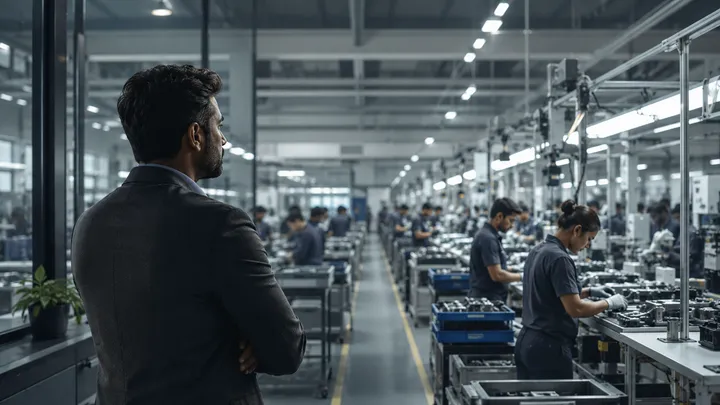
When you are too close to a wall, you cannot see the whole building. You only see the wall. To understand the structure, you have to step back.
Problems also work like that.
How to Use It When Life Feels Too Heavy
When stress increases and the mind starts running in circles, the first step is not always to think harder.
Sometimes the first step is to stop.
Just stop for a moment.
Take a short break. Move away from the place, person, screen, meeting, message, or situation if possible. It may be for ten minutes, a few hours, or one day, depending on the seriousness of the matter.
Then come back with a fresh mind and ask:
“What if this same situation was happening to my friend?”
Imagine the same problem, but remove yourself from the center.
Put someone else there. A friend. A business partner. Or even Amitabh Bachchan, if that helps your imagination. Really, who cares?
Now observe.
- What is happening?
- Who is involved?
- What is each person feeling?
- What does the situation need?
- What is the system saying?
- What is emotion saying?
- What is fact, and what is only fear?
Slowly, your mind starts shifting from reaction to observation.
And once observation starts, clarity starts.
What Usually Comes After Clarity
When you see the problem from a little distance, something changes.
You may not get a perfect solution immediately, but you will usually start seeing one of these:
- a possible solution
- an opportunity hidden inside the problem
- a reflection about your own role
- acceptance of what cannot be changed
- learning from what went wrong
- empathy for the other person
- a better next step
Sometimes the answer is not about winning the situation.
Sometimes the answer is about understanding it better.
Why This Works
- Biologically, when we are under stress, our body prepares for survival. Fight, flight, freeze. In that state, the brain does not always think deeply. It tries to protect us quickly.
- Psychologically, personal problems activate identity. We start thinking, “Why me?”, “What will people think?”, “How could they do this?”, “What if this goes wrong?”
- Philosophically, we suffer more when we are attached to only one version of the story.
Third person thinking creates space between the event and our reaction.
And in that space, wisdom has a small chance to enter.
This is useful not only in personal life, but also in business.
- Before reacting to a staff mistake, step back.
- Before blaming a client, step back.
- Before taking a big decision in anger, step back.
- Before assuming that the whole system is wrong, step back.
Many times, the solution is not hidden.
We are just standing too close.
Maybe the real maturity is not in solving every problem immediately, but in learning how to see our own problem as clearly as we see someone else’s.
So the next time life feels too heavy, maybe the question is not “Why is this happening to me?” — maybe the question is, “If this was not my problem, what would I clearly see?”

Chirag Gadara
System Thinker & Technopreneur
With over 18 years of experience across technology, automation, and enterprise systems, I help businesses eliminate bottlenecks and engineer simplicity for sustainable growth.