What China’s Manufacturing Culture Made Me Think About Indian SMEs
In this article
What China’s Manufacturing Culture Made Me Think About Indian SMEs
I have never visited China personally.
So this is not a travel experience. This is not a judgment. And definitely, this is not a China versus India discussion.
But over the years, I have heard similar observations from many people in my network who have visited China for business. Recently, my partners also went there on a business tour. They visited one factory, observed the working style, met people, saw the shopfloor, and then shared their experience with me.
Some parts of that conversation stayed in my mind.
Not because China is perfect. No country, no culture, no business system is perfect.
But sometimes, when we observe another system from a distance, it becomes a mirror for our own system.
And that mirror made me think about Indian SMEs.
One Factory Visit, Many Small Signals
During their visit, they noticed that in that factory, many women were handling management, marketing, administration, coordination, and communication work. Men were more visible in physical shopfloor activities.
Now, I do not want to generalise this for all of China. One factory cannot represent an entire country.
But the observation was interesting because it showed role clarity. People seemed placed with purpose. Work was divided. Responsibilities looked visible.
Another thing they noticed was hospitality.
Even when you are not going to buy immediately, even if you are visiting only for knowledge, observation, or relationship building, they treat you seriously. You are not made to feel like a timepass visitor.
This is a very powerful business signal.
Hospitality in business is not only about offering tea, coffee, or lunch. We Indians are already good at warmth and relationships.
But business hospitality is slightly different.
- It means preparation.
- It means seriousness.
- It means respect for opportunity, even when opportunity is not confirmed yet.
That itself says something about business maturity.
The Shopfloor Observation
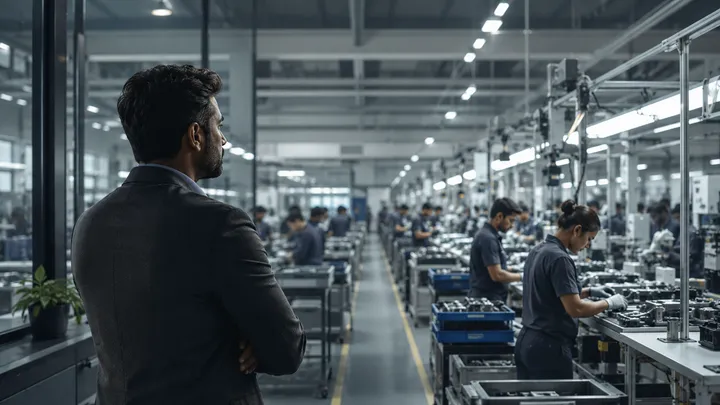
The most interesting part was the shopfloor.
When the visiting team walked through the manufacturing floor, workers continued doing their work. The visitors stopped near some workstations. They discussed internally. They picked up some items to observe. They kept them back.
But workers did not keep looking at them.
No unnecessary curiosity. No attention shift. No sudden slowdown. No “who came?” energy.
They continued working like the work itself was important.
This small observation made me think.
In many Indian SMEs, when the owner enters the floor with guests, suddenly the environment changes. Some people start looking. Some become extra active. Some become nervous. Some wait for instructions. Some just pause for a moment to understand what is happening.
And I am not saying this to blame anyone.
This happens because our work culture in many places is still person-driven.
- When the owner is present, work becomes serious.
- When senior management is watching, speed increases.
- When someone asks for an update, pending work suddenly moves.
So the deeper question is not whether Indian workers are good or bad.
The deeper question is:
Have we built a workplace where work moves because the system is clear, or only because someone important is watching?
Work Should Not Depend Only on Watching
In many businesses, people work because they are reminded.
Because they are asked.
Because they are followed up.
Because the owner is behind them.
But in a mature work culture, people work because the work is theirs.
This is a very big difference.
When employees work only because someone is watching, the owner becomes the system.
And when the owner becomes the system, business growth creates stress.
Because every small thing needs attention. Every pending task needs pushing. Every follow-up needs reminding. Every delay comes back to the owner.
At some point, the owner starts feeling:
“Unless I ask, nothing happens.”
But maybe the problem is not only people.
Maybe the work itself is not clearly designed.
Speed Comes From Uninterrupted Attention
Another point my partners noticed was speed.
Repeated assembly-type work was happening with a sharp rhythm. Fast, focused, and continuous.
This made me think of a very simple truth:
Speed does not come only from working fast. Speed comes from uninterrupted attention.
If a person is constantly distracted, confused, interrupted, called for random work, waiting for approval, or not clear about priority, speed will naturally reduce.
In many Indian SMEs, delays are not always because people are careless.
Sometimes delays happen because systems are unclear.
- Who has to approve this?
- What is today’s priority?
- Where is the required material?
- Who checks quality?
- Who updates the customer?
- What happens if work is stuck?
- Who takes the next action?
If answers are not clear, people cannot perform with rhythm.
Even good people slow down in unclear systems.
What Business Owners Can Learn
The learning is not to copy China blindly.
Our culture, people, business environment, labour conditions, and market behaviour are different. We should not romanticise another country’s system without understanding its full reality.
But we can still learn from the visible discipline.
For business owners, the first learning is role clarity.
People should know what they are doing, why they are doing it, and what result they are responsible for.
Second, reduce owner dependency.
If productivity increases only when the owner is present, the business is not yet running on ownership. It is running on pressure.
Third, build review systems, not reminder systems.
A reminder says, “I have to push you again.”
A review system says, “We have a rhythm where work is checked, measured, improved, and completed.”
Fourth, create a focused workplace.
Random interruptions, unclear priorities, frequent changes, and verbal-only instructions silently damage productivity.
Many times, we ask employees to work faster, but we do not give them a system where fast work is possible.
What Employees Can Learn
If any employee, worker, executive, or manager reads this, the learning is also simple.
Your work is not small.
Whether you are in production, sales, accounts, dispatch, admin, marketing, support, or customer service, your attention affects the entire business.
- A missed follow-up can lose a customer.
- A wrong dispatch can damage trust.
- A delayed quotation can shift business to a competitor.
- A careless production step can create rework.
- A pending payment reminder can affect cash flow.
The owner may not always see every action.
But the business feels every action.
When you work only because someone is watching, you remain replaceable.
When you work with ownership, you become valuable.
Can We Build This Culture in Our Own Organisations?
Yes, but not with one motivational speech.
Culture is built through repeated clarity.
Start small.
- Define roles clearly.
- Write important processes.
- Set daily and weekly priorities.
- Review without insulting people.
- Train patiently.
- Reward ownership, not only obedience.
- Reduce confusion before blaming speed.
- Create systems where good work becomes normal.
And owners also have to change.
If we want responsible teams, we have to stop running everything through our personal memory, mood, and last-minute instructions.
A mature business does not depend only on who is watching.
It depends on clarity, rhythm, responsibility, and review.
Maybe China’s manufacturing strength has many reasons behind it. Policy, infrastructure, scale, discipline, cost, systems, history — everything has a role.
But from these repeated observations, one thing is worth thinking about for us:
Can we build Indian workplaces where people work with full attention and ownership, even when nobody is watching?
If this made you think about your own business, share your thoughts. Where do you feel this problem appears most — shopfloor, sales, operations, admin, follow-up, or team ownership?

Chirag Gadara
System Thinker & Technopreneur
With over 18 years of experience across technology, automation, and enterprise systems, I help businesses eliminate bottlenecks and engineer simplicity for sustainable growth.
Previous Posts From Founder Reflections

The Courage to See Yourself Clearly

The Third Person Theory: Why Problems Look Clear From Far Away

Business Problems Are Not Always Outside

Learn to Say No: The Hidden System Behind Real Growth