Your Business Is Already Running on a System. Is It the Right One?
In this article
Your Business Is Already Running on a System. Is It the Right One?
Many business owners tell me, “Chiragbhai, our business has no proper system yet.”
But when I observe the business closely, I usually feel one thing:
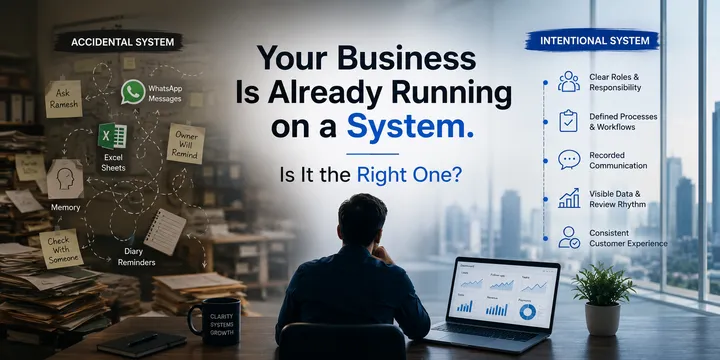
The business already has a system. It is just not visible, documented, or intentionally designed.
Someone knows how quotations are prepared. Someone knows which customer needs urgent follow-up. Someone remembers which vendor gives better rates. Someone knows how payments are chased. Someone knows which staff member handles which task.
So yes, there is a system.
But mostly, it is running inside people’s memory, habits, shortcuts, WhatsApp messages, verbal instructions, and “we always do it like this” type of logic.
And that is where the real question starts.
The question is not whether your business has a system. The question is whether your system is intentional or accidental.
The Invisible Operating System of Your Business
Every company has an operating system.
Not only software operating system like Windows or Linux. I am talking about the internal business operating system.
It includes:
- How work starts
- Who takes responsibility
- How information moves
- How decisions are made
- How follow-ups happen
- How mistakes are corrected
- How customers are handled
- How the owner gets visibility
In many SMEs, this system is not written anywhere.
It is created slowly over time through habits.
One employee starts maintaining leads in Excel. Another keeps follow-up reminders in diary. The owner tracks important things in memory. Sales team discusses customer status on WhatsApp. Accounts team waits until someone asks for payment status. Production team starts work only after verbal confirmation.
Nothing looks wrong at first.
In fact, this style works in the early stage because the business is small, people are close, and the owner is personally involved in everything.
But as the business grows, the same invisible system starts becoming a bottleneck.
Accidental Systems Feel Comfortable, Until They Start Costing You
An accidental system is not created by design. It simply happens.
It feels natural because everyone gets used to it.
But slowly, it creates problems like:
- Missed follow-ups because nobody clearly owns the next action
- Delayed quotations because details are scattered
- Staff confusion because instructions were given verbally
- Owner dependency because only the owner remembers the full picture
- Payment follow-up gaps because there is no review rhythm
- Customer experience variation because every person handles things differently
This is why I often say:
Memory is not a management system.
Memory is useful. Experience is valuable. Personal involvement is important.
But if your business depends too much on memory, then growth becomes stressful. Because every new customer, new employee, new order, and new decision adds more load on the same mental system.
And at some point, the owner starts feeling:
“Everything comes back to me.”
That is usually not a people problem. It is a system design problem.
Intentional Systems Create Clarity
An intentional system does not mean a heavy corporate-style process.
It simply means:
The important things in business are clearly defined, visible, repeatable, and reviewable.
That is all.
For example:

| Accidental Way | Intentional Way |
|---|---|
| “Ask Ramesh, he knows.” | Clear responsibility is assigned. |
| “Check old WhatsApp chat.” | Customer communication is recorded properly. |
| “Owner will remind.” | Follow-up date and owner are defined. |
| “We will see later.” | Review rhythm is fixed. |
| “Everyone knows the process.” | Process is documented simply. |
Intentional systems reduce confusion. They make teamwork easier. They help new staff understand faster. They help the owner review without constantly chasing everyone.
Most importantly, they make the business less dependent on individual memory and more dependent on clear structure.
A Simple Test: Is Your Current System Helping or Hiding?
Here is a small self-check for your business.
Ask these questions honestly:
- If one key staff member is absent for 3 days, does work continue smoothly?
- Can you check the current status of any lead, order, payment, or task within 2 minutes?
- Do your team members know exactly what happens after a new inquiry comes?
- Are follow-ups happening because of a system or because someone remembers?
- Can a new employee understand your process without disturbing five people?
- Do you review work through data or through repeated verbal updates?
If the answer is mostly “no”, then your business is not system-less.
It is just running on an accidental system.
And accidental systems are difficult to scale.
Software Comes Later. Clarity Comes First.
Many businesses directly jump to software when they feel things are messy.
CRM. ERP. Automation. WhatsApp bot. Dashboard.
All these can be useful. Very useful, actually.
But only when the thinking behind them is clear.
Because software will not magically fix unclear responsibility, undefined follow-up rules, weak review habits, or confused workflow.
In fact, if the process is unclear, software can make confusion look more digital.
So before asking, “Which software should we use?” A better question is:
What exactly should happen, who should do it, when should it happen, and how will we review it?
Once this clarity comes, technology becomes powerful.
Without clarity, technology becomes another place where data goes to sleep.
Build the System You Actually Want
A business system should not be created only to control people.
It should be created to make work clear.
A good system helps the owner, the team, and the customer.
- The owner gets visibility.
- The team gets direction.
- The customer gets consistency.
- The business gets stability.
That is the real purpose of system thinking.
Not complexity. Not paperwork. Not unnecessary rules.
Just clear, simple, repeatable ways of working.
Michael Gerber, in The E-Myth Revisited, explains this idea beautifully — a business should not depend only on the owner’s personal effort; it should be built in a way that ordinary people can follow and improve.
That thought is very practical for SMEs.
Because the goal is not to remove the owner from the business suddenly.
The goal is to reduce unnecessary dependency and increase business capability.
Final Thought
Your business is already running on a system.
Maybe it is running on discipline. Maybe it is running on memory. Maybe it is running on WhatsApp. Maybe it is running on shortcuts. Maybe it is running on the owner’s constant follow-up.
But it is running on something.
So the real growth question is:
Is your business running on a system you designed, or on a system that happened by accident?
Because accidental systems can run a business.
But intentional systems help a business grow.
If this made you think about your own business, share your thoughts. Where do you feel this problem appears most — sales, team, operations, follow-up, or decision-making?

Chirag Gadara
System Thinker & Technopreneur
With over 18 years of experience across technology, automation, and enterprise systems, I help businesses eliminate bottlenecks and engineer simplicity for sustainable growth.