Growth Is Not Just Ambition, It Is Responsibility

In this article
Growth Is Not Just Ambition, It Is Responsibility
In my previous reflection, I wrote about why some business owners keep growing while others stay stuck.
After writing that, one more thought stayed in my mind.
Why should a business owner even think about growth?
Many people immediately connect growth with money. More turnover. More profit. Bigger office. Better lifestyle. And yes, these things may come as part of growth.
But I feel growth is not only about personal ambition.
For a business owner, growth is also a responsibility.
When a business grows, it does not only change the owner’s life. It creates jobs. It supports families. It helps employees pay school fees, medical bills, home loans, daily expenses, and future dreams.
A stable business becomes a support system for many people.
This is why I personally feel that if we have the ability to grow, improve, build systems, create employment, and serve more people, then we should not ignore it.
In simple words, if we can do it, we must try to do it.
- Not because of ego.
- Not because of competition.
- But because business is not a fully personal thing. It has a social role also.
Growth Mindset Is Not Just Positive Thinking
Many people misunderstand growth mindset.
They think growth mindset means always thinking big, taking risks, staying motivated, and speaking confidently.
But real growth mindset is much deeper and quieter than that.
Growth mindset means accepting that the current version of our business is not the final version.
It means asking:
- Can this process become simpler?
- Can my team work better without depending on me every time?
- Can customers get faster response?
- Can follow-ups happen on time?
- Can quotation, payment, production, or delivery become more systematic?
- Can I learn something new that improves my business?
Growth mindset is not noise. It is not only expansion.
Growth mindset is a habit of improvement.
A business owner with growth mindset does not say, “This is how we have always done it.”
He asks, “Is there a better way to do this now?”
That one question can change the direction of a business.
Before Growth, We Need Readiness
Growth is attractive when we see the success of others.
But when we start walking on the path, we realise that growth needs mental readiness first.
Without readiness, even good opportunities feel like pressure.
I have seen many business owners who want growth, but they are not ready to change their working style.
- They want more business, but still depend on memory for follow-ups.
- They want team accountability, but have no clear process.
- They want automation, but the basic workflow is unclear.
That creates confusion.
Growth does not start from software, marketing, or hiring.
Growth starts from the owner’s mind.
Keep the Mind Open
The first requirement is an open mind.
If we already believe that we know everything, then nothing new can enter.
Sometimes we have to keep our ego aside and accept a simple truth:
“I may be good at what brought me here, but I may still need to learn what will take me ahead.”
That is not weakness.
That is maturity.
An empty glass can receive fresh water. A full glass cannot.
In business also, if our mind is already full of fixed beliefs, old habits, and “I know everything” attitude, then new ideas will simply bounce back.
Develop an Explorer Mindset
A growth-minded owner is like an explorer.
He does not accept every new idea blindly, but he also does not reject everything immediately.
- He observes.
- He questions.
- He experiments.
He looks at one small problem and asks, “What is the real reason behind this?”
For example, if follow-ups are missed, the normal reaction is to blame the sales person.
But an explorer asks:
- Was the follow-up clearly assigned?
- Was the date visible?
- Was there any reminder?
- Was the customer stage properly defined?
- Was the team trained on what to say next?
This is where system thinking begins.
Instead of blaming people every time, we start improving the system around people.
Feed Better Inputs to the Brain
Mindset is not magic.
It is the condition of our thinking system.
And thinking depends on input.
What we read, watch, listen to, discuss, experience, and repeatedly think about slowly becomes the raw material of our ideas.
If the brain receives poor input, it will mostly produce poor ideas.
If the brain receives better input, slowly it starts producing better questions, better decisions, and better direction.
This is why reading is important.
Not just random reading. Read in the area where you want to improve.
- If sales is weak, read about sales process and customer psychology.
- If team dependency is high, read about delegation, leadership, and systems.
- If operations are chaotic, read about process improvement, Lean thinking, or basic management practices.
Because many times, the owner is not running the business.
The owner has become the business.
And that is a risky position.
Growth Is a Long Journey
One important awareness is this: growth is not instantly visible.
It works like farming.
You prepare the land, plant seeds, water regularly, protect the crop, and wait. For many days, nothing exciting is visible. But under the soil, something is happening.
Business growth also works like that.
You may improve follow-up process today, train your team next week, implement CRM next month, improve quotation format after that, and build review discipline slowly.
For some time, results may look small.
But after a certain point, these small improvements start compounding.
That is why patience is important.
Growth is not one big event. It is the result of many small correct actions repeated over time.
Be Ready for the Rollercoaster
The growth journey is not a straight road.
It is more like a rollercoaster.
- Some days you will feel, “Now things are moving.”
- Some days you will feel, “Why did I even start this?”
You may face team resistance. Customer delays. Cash flow pressure. Failed experiments. Wrong hiring. Software adoption problems. Process discipline issues.
This is normal.
Negative outcomes are not always signs of failure. Many times, they are simply part of the game.
The real question is not whether problems will come.
They will.
The real question is whether we will learn, adjust, and keep moving.
A Simple Awareness Checklist
Before shifting seriously towards growth, every business owner should ask:
- Am I ready to learn again?
- Am I ready to accept that some of my current methods may be outdated?
- Am I ready to build systems instead of depending only on people and memory?
- Am I ready to face slow results in the beginning?
- Am I ready to handle both positive and negative surprises?
- Am I ready to continue even when early efforts do not show immediate return?
These questions are simple, but not small.
They decide whether growth will become a serious journey or just another temporary excitement.
The First Step Is Enough for Today
There is a well-known thought that the journey of a thousand miles begins with one step.
In business, we do not need to solve everything on day one.
We only need to start moving in the right direction.
- One better follow-up system.
- One clearer responsibility.
- One improved process.
- One useful book.
- One honest review meeting.
- One small automation after clarity.
This is how growth begins.
Not with noise. With awareness.
Not with ego. With responsibility.
Not with pressure. With purpose.
If this made you think about your own business, share your thoughts. Where do you feel this growth journey needs to begin first — sales, team, operations, follow-up, systems, or your own mindset?

Chirag Gadara
System Thinker & Technopreneur
With over 18 years of experience across technology, automation, and enterprise systems, I help businesses eliminate bottlenecks and engineer simplicity for sustainable growth.
Previous Posts From Business Growth

Why Growth First Feels Like Chaos Before It Becomes Clarity

Everyone Wants an Autopilot Business. Few Are Ready to Build the Runway.

Why Do Some Business Owners Keep Growing While Others Stay Stuck?
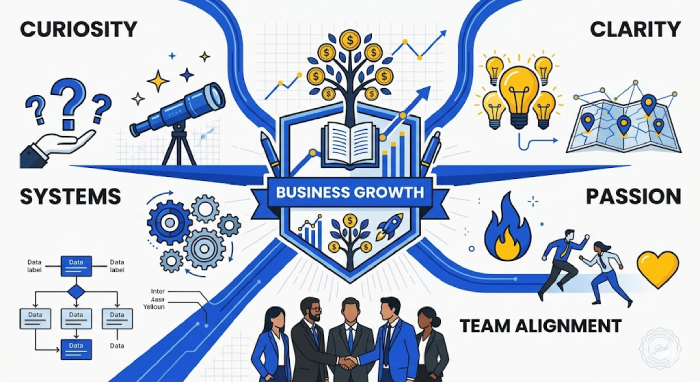
What I Learned About Growth from Curiosity, Clarity and Systems